
Amenities
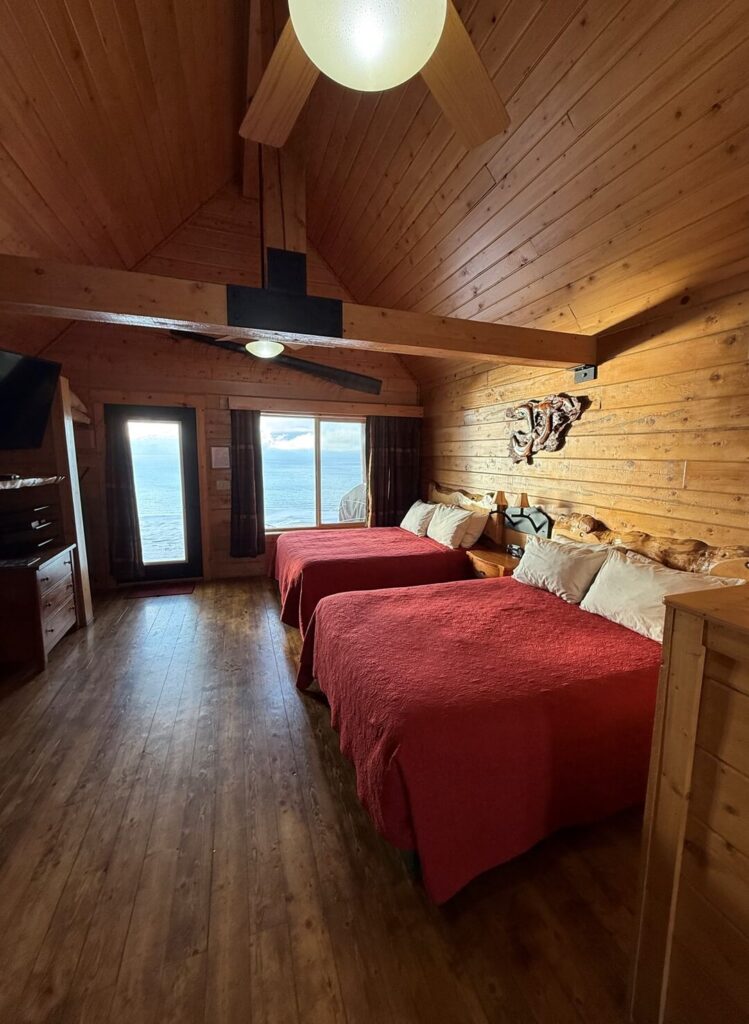
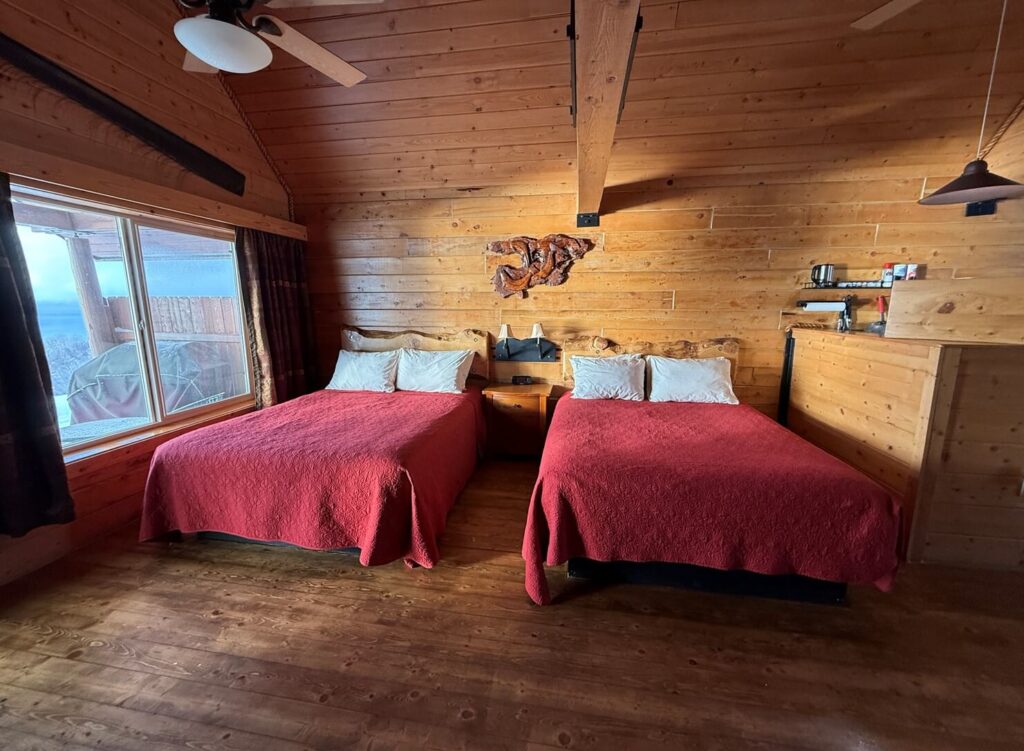
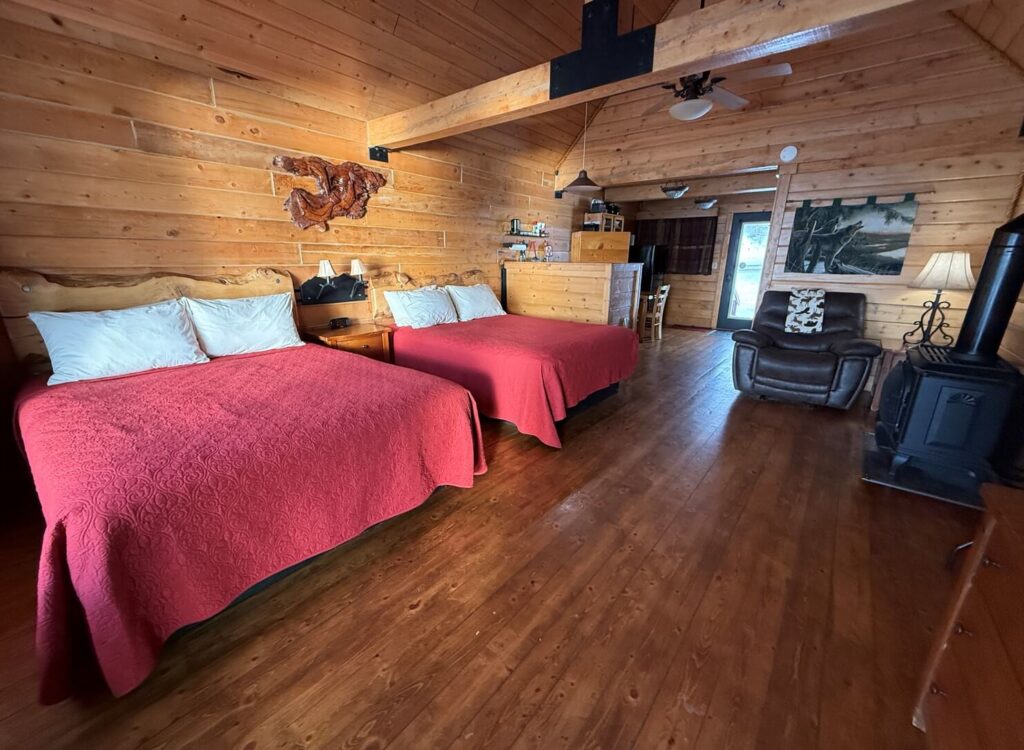
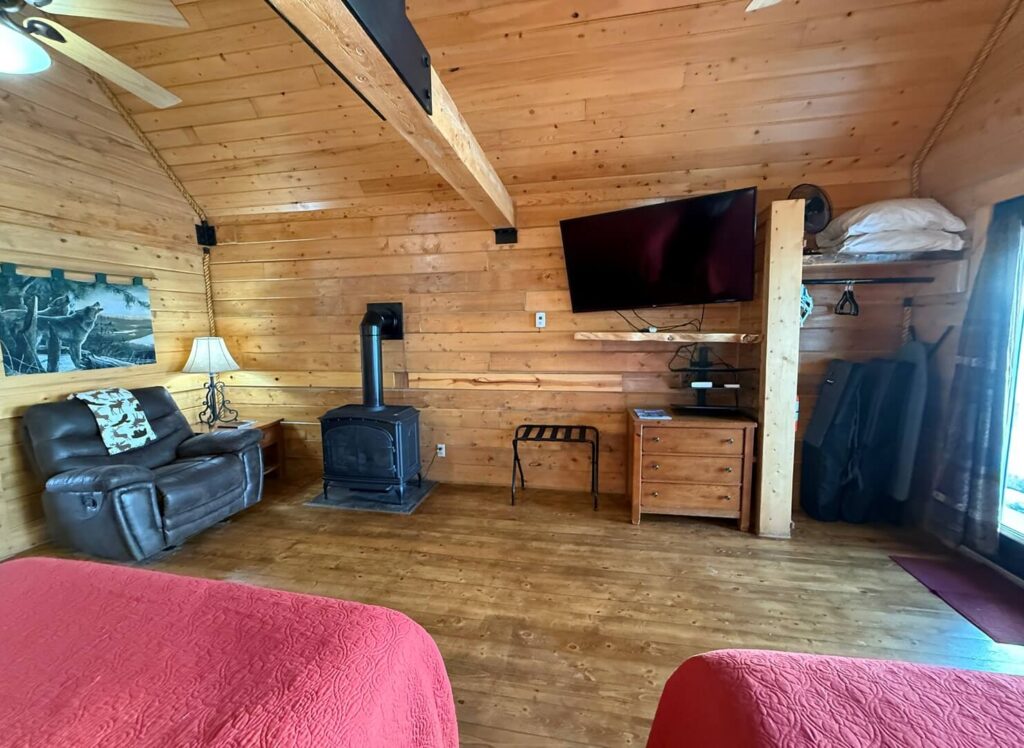
- 2 Queen-size beds
- Kitchenette with a full Refrigerator, cooking utensils, including pots and pans, with place settings
- Full bathroom
- Large screen 50” or larger TV with streaming
- Youtube TV
- Dining room with table and chairs
- Full Grill for each cabin
- 14’ Hot Tub for all 6 cabins
- Firepit
- Fireplace Appliance
- Back porch with chairs to enjoy the view
- Combined bedroom and living room
- Free Wifi
- Ocean view
- Free parking
- 457 sq ft
- Can sleep 5 with the 5 th using a provided rollaway
Click to enlarge Gallery:
Aviation has a special place in the settling of Alaska and is still important to its towns and villages. Even today, there are few roads, and much of the state cannot be accessed by sea. The airplane and the Bush Pilots have filled that need. It has been said that “Alaska needs to fly before it can grow”.1
The first noted flight in Alaska was by James and Lilly Martin in a biplane in 1913.2 In 1924, Cal Ben Eielson was Alaska’s first airmail pilot. The contract only lasted for 8 flights due to 3 crashes. The early years were marked by high death rates. Crashes were occurring every other day with a death every 9th day in 1990.3 This lasted until the Federal Capstone program funded by the FAA, which created the ADS-B (Automatic Dependent Surveillance – Broadcast) system, which provided cockpit data to inform the pilots of their location, but also the location of other aircraft.
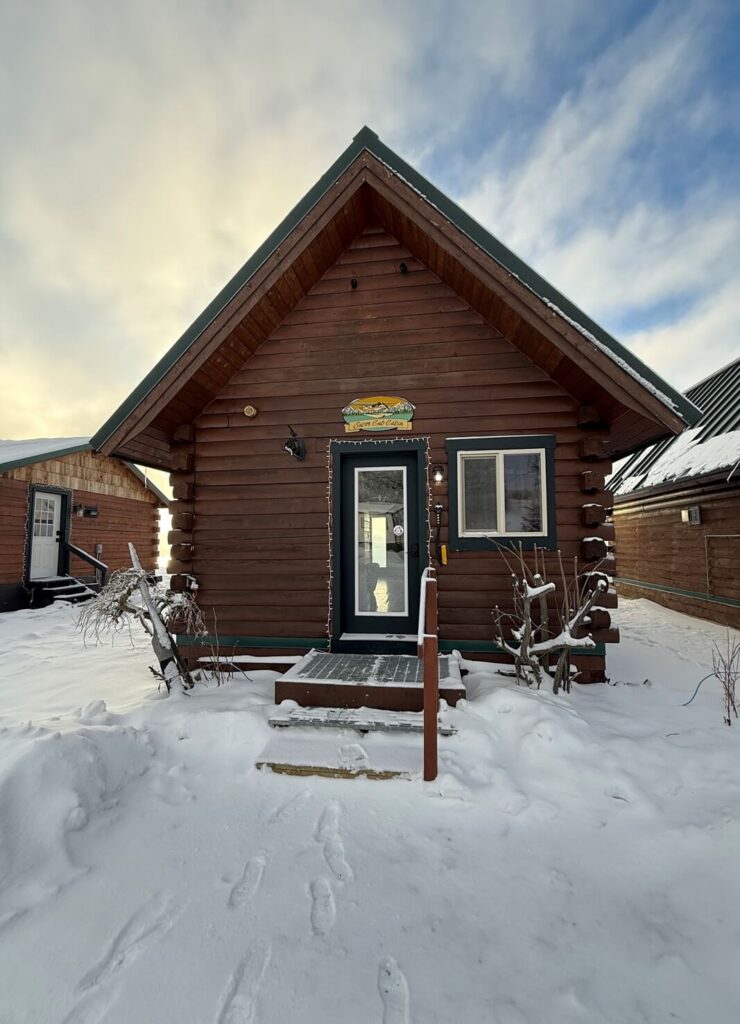
In this environment, a rugged, versatile, great payload-to-weight, and STOL (short takeoff and landing) aircraft was needed. The Super Cub by Piper fits this need.
In 1949, Piper Aircraft Inc., still in operation today, developed the Piper PA-18 Super Cub. The Super Cub list price was $5,850.00 in 1949 when houses sold for $10,000.00.4
During world war 2, Piper sold a Piper J-3 to the military. It saw wide service as a trainer, reconnaissance, ambulance, and supply transport. 5 In 1947, Piper switched its focus to the private market after the newest model developed, the PA-19, failed to win military orders. At this point, they fell back on the PA-18 concept to create the Super Cub PA-18-95 (ATC #1A2).
The first Super Cub had a single 18-gallon left-wing gas tank with an optional 18 gal right wing tank available. It had a Continental C-90 Engine however, no flaps. This model was manufactured until 1961.
The second model was the PA-18-105 with a Lycoming O-235-C1 engine and a larger horizontal tail with flaps.
The next model was the PA-18-125 with a Lycoming O-290-D engine, with the improvement of an oil cooler scoop on the top of the cowling. This oil cooler scoop was moved to the bottom location of the cowling in 1952 in the next model, the PA-18-135, which also added the 2nd fuel tank to the right wing as standard equipment. This model had a Lycoming O-290-D2 engine.
The final configuration was the PA-18-150/160 with an even bigger engine, the Lycoming O-320. This model was introduced in 1954 and was manufactured until 1988. The final price was $45,000. A kit without the engine and prop was sold for $21,000.
There were two other specialty planes, the PA-18s and PA-18a, that were used as a seaplane and for agriculture, respectively.
There were two military models, the L-19s and the L-21s. Most of these ended up in foreign countries.
As you can see from the evolution of the models and the engine sizes below, there was a continuous desire for more performance. In Alaska, with the high mountain ranges and desire for heavier payloads, there were a number of customizations that occurred.
Engines
Continental C90: 90 HP (early models).
Lycoming O-290: 125 HP.
Lycoming O-320: 150-160 HP (later models).
The final factory configuration with the Lycoming O-320 had the following Specifications:
130 mph max speed
100 mph cruise speed,
460mi range
ceiling 19000ft
high power-to-weight ratio
Great visibility with a high wing
2 seat
weight 930lb takeoff
total weight 1750lb
short takeoff and landing distance
fixed tail wheel
Option for skis or floats
When you look at the specs, you can see why the PA-18-150/160 was so attractive to the Bush Pilot, when you are landing on the tundra, where power and visibility are vital!
Even today, the Super Cubs are highly prized! Depending on the condition, maintenance, and modifications, Super Cubs can go as low as $30,000 and as much as $200,000.
1 – https://www.museumofalaska.org/blogs/alaska-s-aviation-legacy–how-planes-changed-everything
2 – https://www.smithsonianmag.com/air-space-magazine/alaska-and-the-airplane-69899341/